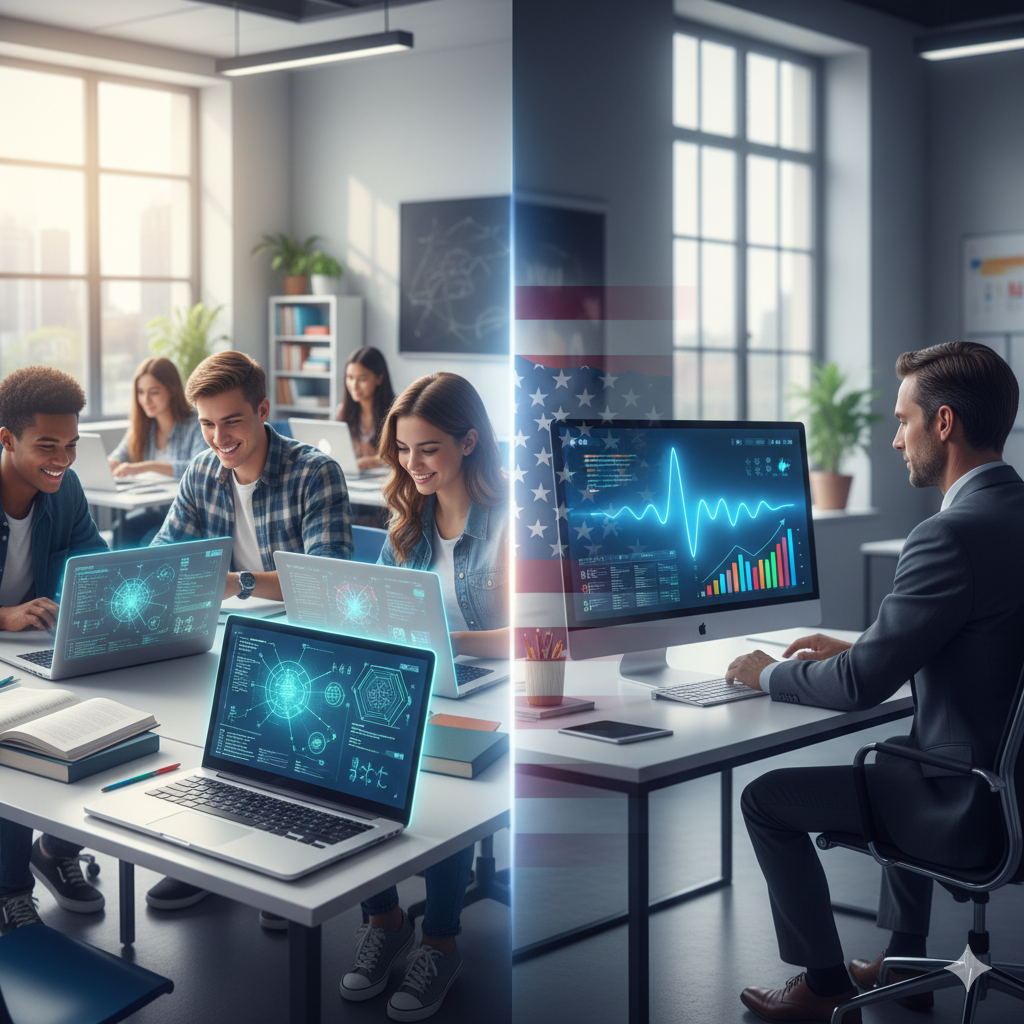
In a powerful convergence of policy and practice, the American workforce is being pushed toward a new era of AI integration from two directions. This month, the White House announced a massive public-private partnership to bolster AI education, just as tech giants like Microsoft and Apple are embedding advanced AI capabilities directly into the operating systems and software used by millions of businesses daily. Together, these initiatives signal a clear and concerted effort to make AI a foundational skill for the entire American workforce.
The federal initiative, detailed in a White House press release, brings together a stunning coalition of the nation’s largest technology and education companies. Major players including Google, Microsoft, Apple, IBM, and Amazon have committed billions of dollars in free training, resources, and software access for K-12 students and teachers. As noted in the announcement by Michael Kratsios, Director of the White House Office of Science and Technology Policy, the goal is to ensure Americans are “equipped to lead the world in harnessing this technology.” The commitments are vast and varied, ranging from Google offering its Gemini 2.5 Pro model to every high school for free, to IBM pledging to skill 2 million learners by 2028 through its SkillsBuild program. This represents the foundation for the emerging New Collar Economy.
From Policy to Productivity
This top-down push for AI literacy is happening in parallel with a bottom-up integration of AI into the core tools of American business. As reported by the Educational Technology and Change Journal, both Apple and Microsoft are rolling out significant AI-powered updates to their operating systems this month. Apple’s “Apple Intelligence” in iOS 19 promises on-device writing tools and a screen-aware Siri, while Microsoft’s Windows 11 update will enhance its Copilot assistant with new automated “Actions” in File Explorer.
This means that advanced AI capabilities for summarizing, drafting, and task automation are no longer specialized tools but are becoming a native part of the daily workflow for millions. Furthering this integration, Reuters reported this week that Microsoft is diversifying its AI engine, adding models from Anthropic (makers of Claude) to its 365 Copilot, giving users more choice and power directly within Word and Outlook. This also allows signals a shift from Microsoft to steer away from overreliance on OpenAI.
A Shifting Job Market
This dual push of education and integration comes at a critical time for the U.S. labor market. As we analyzed in our report yesterday, “The White-Collar Squeeze,” the professional workforce is already navigating significant disruption. A new September 2025 Labor Market Update from Indeed confirms this trend, noting that while the job market is not in crisis, it is “stagnating.”
The report highlights that job postings for junior or entry-level roles have seen a notable decline. According to Indeed’s analysis, this “squeeze on new entrants” stems from an overall slowdown in hiring rather than a specific bias against junior roles. For HR leaders, this landscape presents a dual challenge: managing the current stagnation while simultaneously preparing their existing workforce for a future where the skills being taught in schools today will soon become the baseline expectation for productivity tomorrow. Welcome to the New Collar Economy!